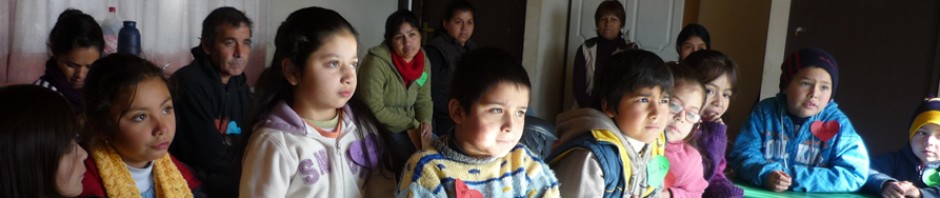
Before leaving the county of Coltauco in the country’s 6th region, I stopped in to show the photos of the workshops in Rinconada de Parral to the mayor. As a very kind gesture of gratitude, he authorized the use of the Senior Citizen’s Center that the Municipality owns on the coast, a little to the south of Pichilemu (surfing capital of Chile! Surfers brag that if another tsunami comes they’ll “surf it!”). My plan changed a bit (quite a bit) and instead of going much more south into the 7thregion, I went south- west and right into a beautiful, millennial paradise called “Laguna de Cahuil”.
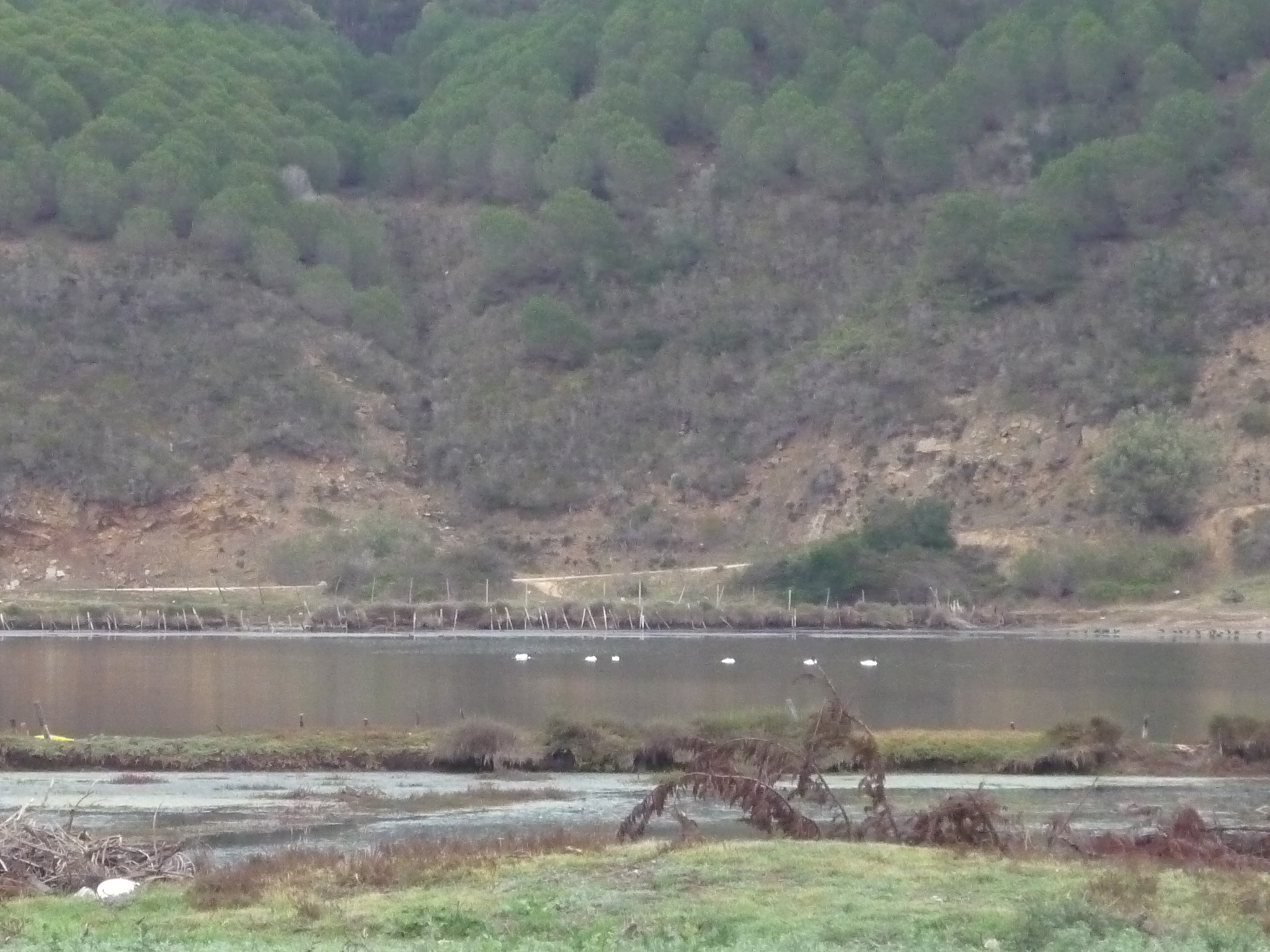
view of the Laguna from my bungalow
In times past Laguna Cahuil was one of the major salt producers, being that there was just the right mixture of sea water and fresh water. According to legend, at the time the first Spaniards arrived, salt was being taken from holes in the area and used for trading. The Spaniards took over the salt trading business. “The salt road” ran from Cahuil through the Rinconadas (along the mountains) to Rancagua (and then probably off to Santiago). A twenty mule train carried the bags of salt. The lead mule or “God-mother” wore a bell around her neck. This practice actually continued up till forty years ago. The salt train would stop at different “inns” along the way. A train was put in around the early 1900’s, which ran east from the coast near Cáhuil, dropping off cars of salt at large meat processing plants; other agro – industries along the way; and ending up at the large copper mine (“El Teniente” – first owned by the US in the early 1900’s as the Braden Copper Co., a subsidiary of the “Kennecott Copper Co.”) against the Andes Mountain slopes. Now, at this point in history, I couldn’t even find the train tracks.
The surrounding banks of the Laguna Cahuil now contain only the ghostly remains of the squares and the ruins of painstakingly prepared dykes to allow just the right amount of water in, which would then evaporate…leaving the precious salt. Last year’s earthquake and tsunami changed the contour of the beach, blocking the mouth of the Laguna from the sea with a wide stretch of beach. A lonely digger works despairingly away from dawn to dusk, scooping away a channel through the beach to allow the sea entrance into the Laguna. Sand, being what it is, just fills the channel in again. Now the Laguna Cahuil has become home to a host of birds: swans (of various types) have taken over the ruins of the salt beds; beautiful wood ducks, and other sea birds hang out in the Laguna.
Since the earthquake and tsunami, many of the men have had to go to other areas to look for work, leaving the women and children to fend for themselves. The need to survive has created a delightful mix of activities: practically everything that pops up from the ground is pickled or made into jam; put into decorated bottles, with cute labels, and sold to tourists. Cahuil cultivates a small papaya, which is a favorite. Then of course there’s the delicious blackberry jam. They get every blackberry off the vine. It’s a good thing there are no bears here, as they’d die of starvation or end up pickled! Quinoa is also grown to sell. The forests which extend up the mountain slopes from the Laguna are home to mushrooms and edible fungus. Women scour the forests, collecting mushrooms, and fungus, which are then pealed, dried, and sold to different buyers who come through periodically. Some women hand weave wool into yarn; others knit or embroider. Others have mud brick ovens in which they bake bread, “empanandas”, and other delicacies. Then, of course, there are the arts and crafts. Every poor shell that washes up on the beach is transformed into a lovely, creative, knick-knack! The men who stay in Cahuil either fish, or spend their lives diving into the frigid waters of the southern Pacific to get shell fish. Both women and men scour the sea for kelp, sea weed, and “sea lettuce”, which buyers are shipping off to China (big market there!). It’s a tough life, but then again, not as tough as it used to be (according to Julia de la Mercedes – who’s 102 years old – and still going strong!)
The people are all eager to tell me about the miracle that happened to save their “one long street town” (it goes along the Laguna from the sea). Many houses were destroyed or badly damaged in the earthquake, which started as a rumbling sound from the depths of the mountain. Everyone from the town scrambled up the mountain. Some of the children couldn’t find their shoes in the dark and ran barefoot through broken glass around their homes on their way out. They reached a higher part of the mountain behind the town with their feet bleeding and infected (in our workshops, we’re emphasizing each child keeping a ‘flee- bag’ with important items … including shoes). From the top they could see the tidal wave approach. It looked like the town would be covered. Then something amazing happened: the huge wave broke against the bridge (which had just been built three years earlier) and sprayed in a colossal display of water power over the top, but mostly ricocheted off to the sides. Most of the town (except for the houses on the Laguna side of the road, as the Laguna swelled dangerously with water) was spared from flooding. Of course, putting myself in the townspeople’s shoes, it must have been a terrifying sight to behold!
Now a year and a half later, “Sanando Corazones” (Healing Young Hearts) came to the village of Cáhuil.
I’ve got my little routine down now – first step is to visit the City Hall, introduce myself and the project, and answer the inevitable question “Who’s funding this project?” with the answer: “Well, actually, God is – and to do it He’s using some absolutely beautiful people from different parts of the world who love children and are doing something to help the children who are still suffering the trauma of a major disaster. They usually respond with a bit of a shocked look on their faces, as it’s hard for people here now days to comprehend that things can be done through just the motivation of love and concern … as that hinges on the “miraculous”… without the “big bucks” NGO’s or the big promotional schemes behind everything … as that hinges on the “what’s in it for me” philosophy of modern life.
The second step is to begin visiting the communities and schools that have been suggested as being the most vulnerable, as far as effects from the earthquake/tsunami. This step is also where I get my best exercise, as often I find myself trudging for miles along semi – deserted dirt roads between coastal communities. On one such road, along the coast, I could actually see the total expanse of Chile. On my right was the Pacific Ocean and on my left in the distance, I could see the snow caps of the Andes Mountains (the natural border with Argentina)! I take the questionnaires to the schools and have the students fill them out. That’s the indicator of where there is still unresolved trauma.
Well, the Lord certainly led me to the right place! When I got the questionnaires back from the school in Cáhuil, three fourths of the students had marked most of their answers revealing trauma, a number of the children had marked all of them!
Cáhuil is “ two schools in one” since the earthquake, when the community at the end of the Laguna, Barranca, lost its school in the quake. The children from Barranca attend school in Cáhuil and the director of the Barranca school has taken on a position as just a teacher, in order to continue with his students, despite the difficult circumstances. The children must ride to school in winter, in the back of an open pickup truck! Many of the houses in Barranca also fell in the quake, as they were made of mud brick (which, by the way, is a great material to keep in the heat in winter, and keep out the heat in summer). It seems that the earthquake last year consisted of two different and opposing seismic waves, which proved “deadly” for mud brick construction. Most of the construction in this entire area was mud brick, which became the “deadly” recipe for destruction.
At the far end of Laguna Cahuil lies the serene and pastoral community of La Villa. When I arrived in the town, the store fronts were all open wide with the wares quite available to grasp, yet no one was around. I don’t know if there is still such a sense of trust that one just “helps themselves” and leaves the money; or perhaps is expected to “pay later”. Well, since I couldn’t figure the system out, I just went on my way (quite thirsty without that bottle of water I needed so badly!). The school in La Villa also services two communities. The children from La Palmilla must walk or ride their bikes to La Villa (in some cases quite a distance away). On rainy days, they remove their shoes and socks and go barefoot through the mud to school. Upon arriving, they wash their feet and put on their socks and shoes so that they will be ‘dressed neatly’ for school. I found these children to be quite exceptional: they were calm, very interested in their school subjects, helped each other without being told, and were very respectful to both adults and to each other. However, when I mentioned this phenomenon to someone in a larger city, the response was, “Oh, poor kids, the teacher must be way too strict! Thus it has occurred to me that in our sugar-high, technologically hyper, philosophically “super I” society; children who are not disrespectful, disruptive, hyper, egotistical, etc. are considered “abnormal”….my how the norm has shifted!
We did workshops of “Healing Young Hearts” in Cáhuil and Barranca, along with a class that I gave to the children in the LaVilla School. Then I went into the corner community of the 7th region and we did a workshop in Boyeruca. That coastal community suffered a lot of destruction from the tidal waves. The school was destroyed. However, again, there’s a miracle involved. The school had been full of scouts camping out. The big event ended just the day before the earthquake hit. If the earthquake/tsunami would have hit just one day earlier, around 100 young lives would have been lost!
The school principal’s house was located right in front of the school (with a lovely view of the beach!) It just so happened that one of the huge waves had already washed in and was washing out again, when another huge wave came in. The two waves collided with opposing forces right on his house. The entire house was lifted up and swept away, leaving not even a stick or two, as a reminder of its former presence. Nothing of his belongings ever even washed up onto the shore! He and his family had spent that night visiting relatives in another town…..another miracle! Needless to say in Boyeruca there’s a lot of interest in overcoming fear and trauma. I was surprised to arrive at the workshop and discover 16 children and young people waiting for me! We almost didn’t even fit in the little classroom we had been given for the workshop.
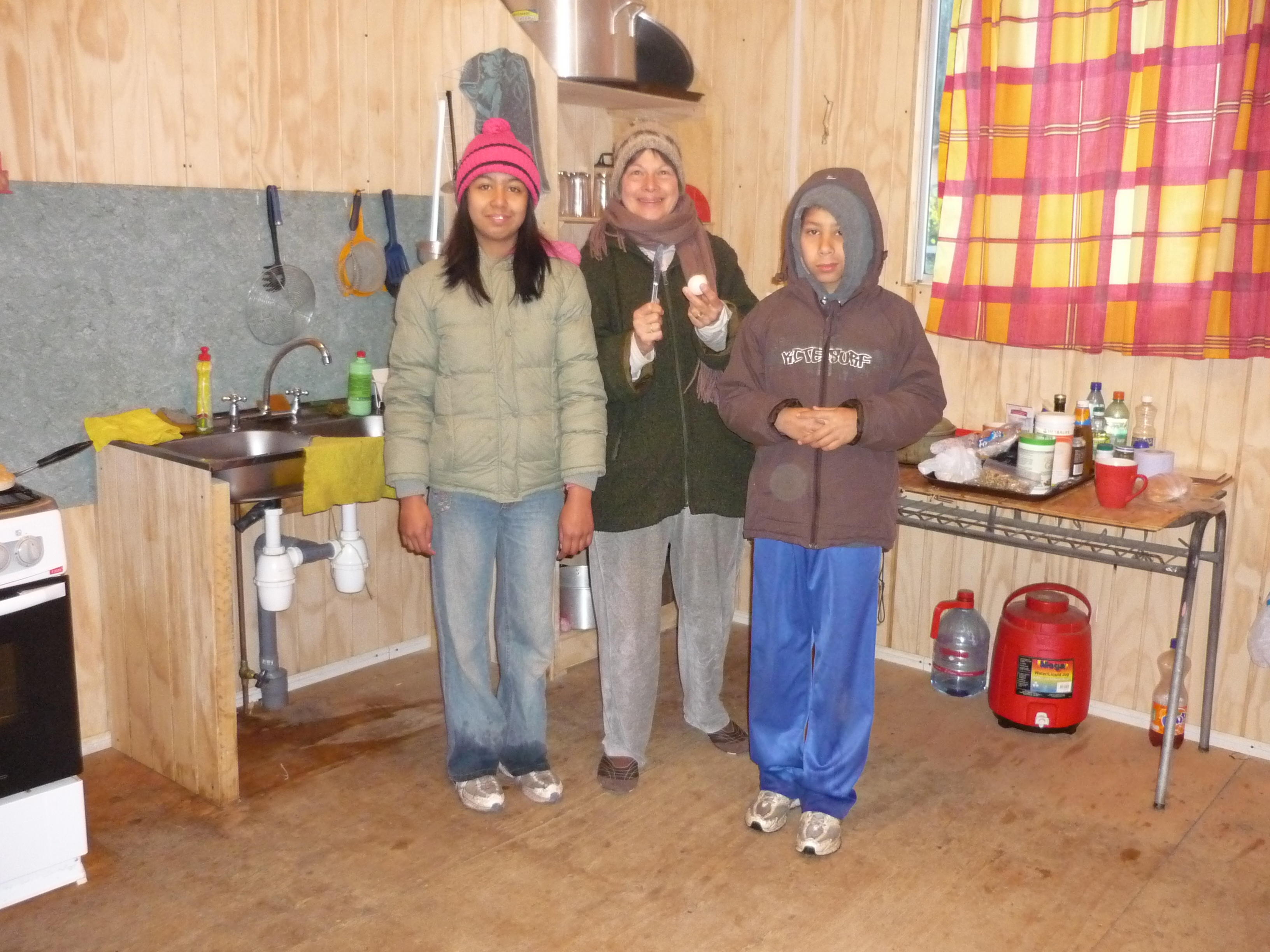
The kitchen facility. One family came from quite far to attend the workshop. So I invited them to supper, as it was quite cold.
I was told that in the fishing villages along the coast several factors make psychological healing difficult for the children. In addition to the destruction from both the earthquake and the tsunami, there are also factors which come into play from the changing society in general. Even people who still claim to be “Christian” don’t seem to grasp how to practically apply the principles of their Christianity in daily life. Lack of communication in the homes, lack of parental guidance, and isolation make young people feel very insecure. There doesn’t seem to be much of a moral fabric to hold things together in many communities. All of this gives rise to problems like alcoholism, incest, infidelity domestic violence, etc.
Fishing is a tough, hard life but it does bring in money, so there’s not a lack of technological gadgets, however it’s not all the best stuff…. Satellite dishes provide vast TV options (even in out of the way places where there’s not a lot of entertainment) but they also provide violence and even pornographic addictions. The fishing villages that are more isolated down the coast have tended to lack both educational and cultural opportunities. There seems to be a lack of parenting skills among the younger parents. All of these factors affect the children in the communities on a daily basis
For some of the children, the school has become a “bastion” of safety and security. Those kids don’t like to go home when the school bell rings! Those children go through big trials when there’s a holiday!
At the close of the workshop in Boyeruca, we were able to pray with the children for faith and encouragement to face life with confidence and conviction in their hearts. I believe that’s the best thing we could do for those children.
I discovered something very interesting in the school in Boyeruca. After the Chilean tsunami, Japan donated a full color photo text book for each school in the 7th and 8th regions of Chile – the title – “How to Prepare for a Tsunami”. Ironic isn’t it? I guess it goes to show that “preparation” is quite a relative term, which is why we can never really be “prepared” without the Lord’s specific guidance.
Now the next area we go to will be south along the coast where the earthquake/tsunami wound is still open and bleeding. Iloca is also a one sreet town that goes between the beach and the mountain behind it. Just recently another tidal wave hit, damaging the houses which were put up after the tsunami. Then last weekend a storm hit the coast and high winds tore the roofs off of some of the houses.
The town’s people don’t really have an option of “moving to higher ground” because the mountain is privately owned and the owner’s not selling!
I am going to need your prayers as the situation will be getting more desperate and depressing physically. I need to have the faith to be positive and encouraging and not get dragged into the “sea of confusion” I’m also going into more isolated areas along the coast, which will be more challenging for me physically.
I want to thank each and every one of you who has helped “Sanando Corazones” keep going through your donations. With all my heart I know that the Lord has called you to share in the rewards as well.
Please remember to drop me a quick little note to let me know when you deposit into either my checking account or Paypal account, along with the amount so I can thank you personally, pray for you, and keep track of the Project finances.
If you haven’t donated yet, but you’re feeling the nudge to commit to even a small monthly contribution, the Sanando Corazones Paypal account is: tamingfears@gmail.com
Of course the biggest commitment is to pray for each other and for the people we’re trying to help.

 tamingfears.com