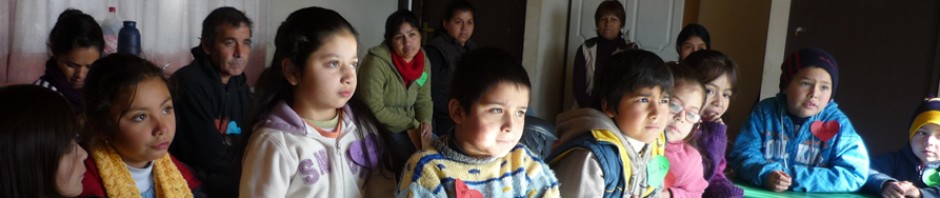
This write up is going to be about people. It can’t be about scenes of beautiful coastal communities of quaint fishing villages, or picturesque homes because it’s too painful to think about such things, as one looks at the destitution and the makeshift wooden shacks that lie on bleak, bare coastal terrain (that used to look so different!). This write-up is going to be about people, because that’s what the “Sanando Corazones” project is all about : people!
What used to be the colonial style city of Constitution lies close to the epi-center of the 2010 earthquake and tsunami. It is also one of the places that suffered a significant loss of life. After the earthquake, we (among many others) made trips to take food, supplies, clothing, blankets, etc. to the makeshift camps of temporary wooden shelters which were set up. It was, on the one hand, a shocking experience – similar to visiting a city which had recently been bombed out. It was also painful to have to listen to the tragic stories of death and destruction that everyone needed to vent. On the other hand, it was exhilarating to see all of the different volunteers, just like us, who were sacrificing their weekends to make long, tiring trips to lug supplies; and work long hours, helping to build the huts or set up the camps, or doing programs for the refugees, who had lost everything between the earthquake and the three biggest tsunamis that followed in its wake. One definitely felt a sense of unity in the air.
Now, over one and half years later, it’s been quite interesting to visit the camps and define what I will call the “social pathology” of long term refugee camps:
What happens when everything you possess is suddenly gone and you are sent to live in a temporary shelter/ dwelling, crowded together with many others like yourself, on a piece of land that’s lent for the purpose of housing you until you can get into a more permanent situation? There are stages that must be gone through. After the initial shock dies down a bit, the survival instinct takes over. The basic needs of water, bathroom facilities, and employment to bring in funds for food, etc. are the main things on your mind. Then you begin to settle into a routine. Time passes. You try to make the best of where you’re at. That’s where the big difference comes in between you and others in your “new community”. If you had a nice home, with a high standard of living, it becomes increasingly difficult to be living in such close quarters with someone who had a very low standard of living and was dysfunctional before the disaster (and has become even more so now).
What should your attitude be toward your “temporary dwelling”? Should you invest time and money in “fixing the place up” to make a nicer “home” for yourself? Or should you save that time and money to invest in your permanent home when it finally materializes? What about these other people who you’re crowded in with? Do you want to go to all the work to try and build a relationship with them, when you’ll be moving on in the (hopefully) near future?
It’s been interesting to compare different sociological situations over time. For example in one of the temporary camps, almost all of the people had lived in an apartment complex which collapsed. In that camp there is a stronger sense of community which has persevered. As a group, they work on projects to “better” their situation. They take trips together and plan activities. Even though there is a growing frustration because nothing has been done as yet to begin the construction of a new apartment complex for them, they maintain their collective sanity through united projects….keeping the awareness that they’re “ all in it together”.
In other temporary camps which have been set up, people were put there from many different places (both socially and physically). Those camps tend to be rife with strife, bickering, and discontent. Depression has settled in because of the lack of reaching any kind of concrete housing goals for their permanent settlement. Along with depression has come inactivity: giving up. In many cases there has been negative comparing and a consumerist spirit has settled in because of a “grabbing a hold” of all the physical aid which has poured in. Psychologically there has been a “grabbing a hold” of every promise made, even though too many promises were made as political leverage , without a foundation and without being carried out.
What do you do when you’re a land owner, but you’re not going to be allowed to rebuild on your property for security reasons….or the price of selling your property is” bottom of the barrel” low at this point in time, being right in the middle of the devastated coastline. You have no place to build, and no money to buy a new piece of property. What do you do when things have gotten so complicated that the entire system has become dysfunctional? What do you do when there are no answers and time just continues to tick away in your life, as months become years?
Now (a bit closer to home), how does one manage it all when they have one foot in two different realities? There’s the world of those still in the camps (or those sitting on their own property, quietly, painfully, trying to stay warm in their make shift shelters, and wondering when they’re ever going to be able to rebuild their homes or their lives).
Then there’s the world of those who haven’ been directly affected and they just can’t’ relate! To them the earthquake/tsunami is ancient history now and life has gone onto more interesting topics. That group doesn’t want to even hear about it anymore (part of that group can even be found right in the affected areas). When there are no answers, the tendency is to turn away to more pleasant subjects.
By the way, what’s happening with me! Why do I break down and start crying at weird moments? Why am I starting to feel exhausted? Why am I fighting a feeling of psychological paralysis? It’s certainly not the “raw” reality that it was right after the quake, where people were mourning their loved ones who had died, anxious over those who were still missing (by the way, in Constitution there are still over ten people missing), huddled in these camps without water, without bathroom facilities. Now they have these things, even though many have to walk at least a block to get water or to the bathroom in pouring rain and freezing cold for two winters now (especially tough for those who have babies and little children).
Well, I think I got my answer (at least about what’s happening to me) from a young woman who sat next to me on the bus one day. She said, “It’s totally exhausting and debilitating when you must pour out faith and hope in a situation where there are no immediate human solutions. It becomes too much. You must have a release or harden yourself” (Hmm, that’s why the head of ‘community development’ in the municipality told me that every day after work he runs and runs and runs until he ‘ runs it all off’).
I’ve discovered that my “release” is being with the children: meeting with them; getting to know their names; helping to give the workshops (which we’ve been able to do in three of the refugee camps in Constitution this last weekend when Margaret came from Santiago. God bless her for her sacrificial spirit!). The kids in one of the workshops didn’t want to leave when it was over!
One young man told us that he enjoys school and he especially enjoys reading – anything he can get his hands on. He said it was thanks to his grand-father (a fisherman) who took him into a little room which was set up as a library. There were many interesting books: Greek philosophers, history of the world, geography, etc. etc. The boy asked his grand-father how far he got in school. The old man’s eyes glinted as he responded, “I never had a chance to go to school. I made a friend who taught me how to read and I’ve kept practicing all my life”. It’s my prayer that for each child that has attended our workshops there will be something that they can “get their mind around” and keep practicing it all their lives.
So, when I start to get “under the cloud”, I’ve decided that I just need to go “share” whatever I can with a child.
A friend also helped me to remember that I need to use “extreme praise” more in my life. That means that there’s nothing that I can’t find something to thank the Lord for in whatever situation. Just the act of finding something to praise the Lord for, helps to renew the balance in whatever perspective I’m facing.
Finally, I need to keep reminding myself of the God-factor. God’s not through with me; and He’s not through with anyone else yet either.
Oh, I almost forgot, I was able to share the materials I have from the project authorized by UNICEF (which we translated into Spanish) with several psychologists who work in the educational and mental health sector of the entire area. They were very interested in using the materials. Their enthusiastic responses made me feel good about all the work we did to select, translate and organize those materials for use over the “long term” in schools.
On a visit to a fishing town along the coast to the south of Constitution, I mentioned about the materials to the school director. He asked if I would be willing to give a teachers’ seminar. I answered “sure” expecting just a few teachers to show up (those who are more interested in what I have to offer as far as working in a school setting with helping children overcome trauma and also making the school facility a focal point in “preparedness” for disaster occurrences). Well, to my shock, all of the teachers showed up! I wasn’t prepared for that! This is certainly a learning experience for me. I need to have my plan A and B ready at all times. Plan A is give the materials to those who are already really interested in disaster preparedness and what they can do to organize their part of the world better, as well as how they can reach out and help the children overcome trauma through different activities incorporated into their curriculums.
Plan B is having a whole “show” prepared for large seminars, where I first “convince” the teachers that they can do therapy activities with their children…. that it is possible…that if they don’t, who will? The teachers themselves must receive training to recognize the long term symptoms of trauma in their students.
As far as preparedness, they must be guided past the “ain’t it awful” attitude to a “what can we do constructively to make things “not so awful” next time attitude. A lot of it boils down to sharing the “passion” that what I have to give them (after all it is material that was prepared for and used in disaster situations around the world) is really what they need to also become more passionate about “taking charge” of their life situation and not just psychologically “hiding from it”.

 tamingfears.com