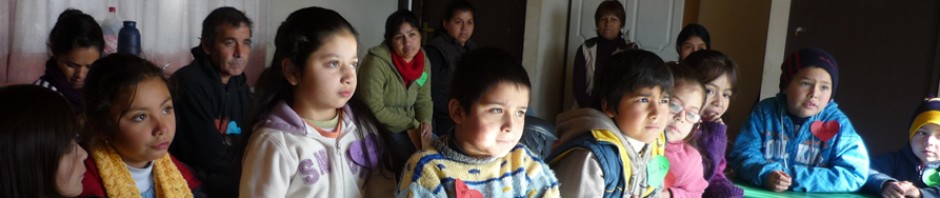

the afternoon snack, made available by the local supermarket and the drinks provided by a small little shop, which is running in a shelter, because their store was destroyed in the earthquake.
Having done the workshops for the children in the refugee camps in Constitucíon, it was requested that we do something to help the mothers also. We have gotten a larger team together in order to do an all day seminar with different activities to help ease their emotional pain and stress, which they’ve been living with for almost two years now…..plus the pain from all of the peripheral problems which have come along as side-effects: loss of major sources of income; husbands having to leave the area to go to different parts of Chile to find work (or sometimes just leaving), mothers alone struggling with caring for themselves and their children under difficult living conditions; cramped quarters in their temporary wooden shelters (as well as the fact that the shelters have been crammed in
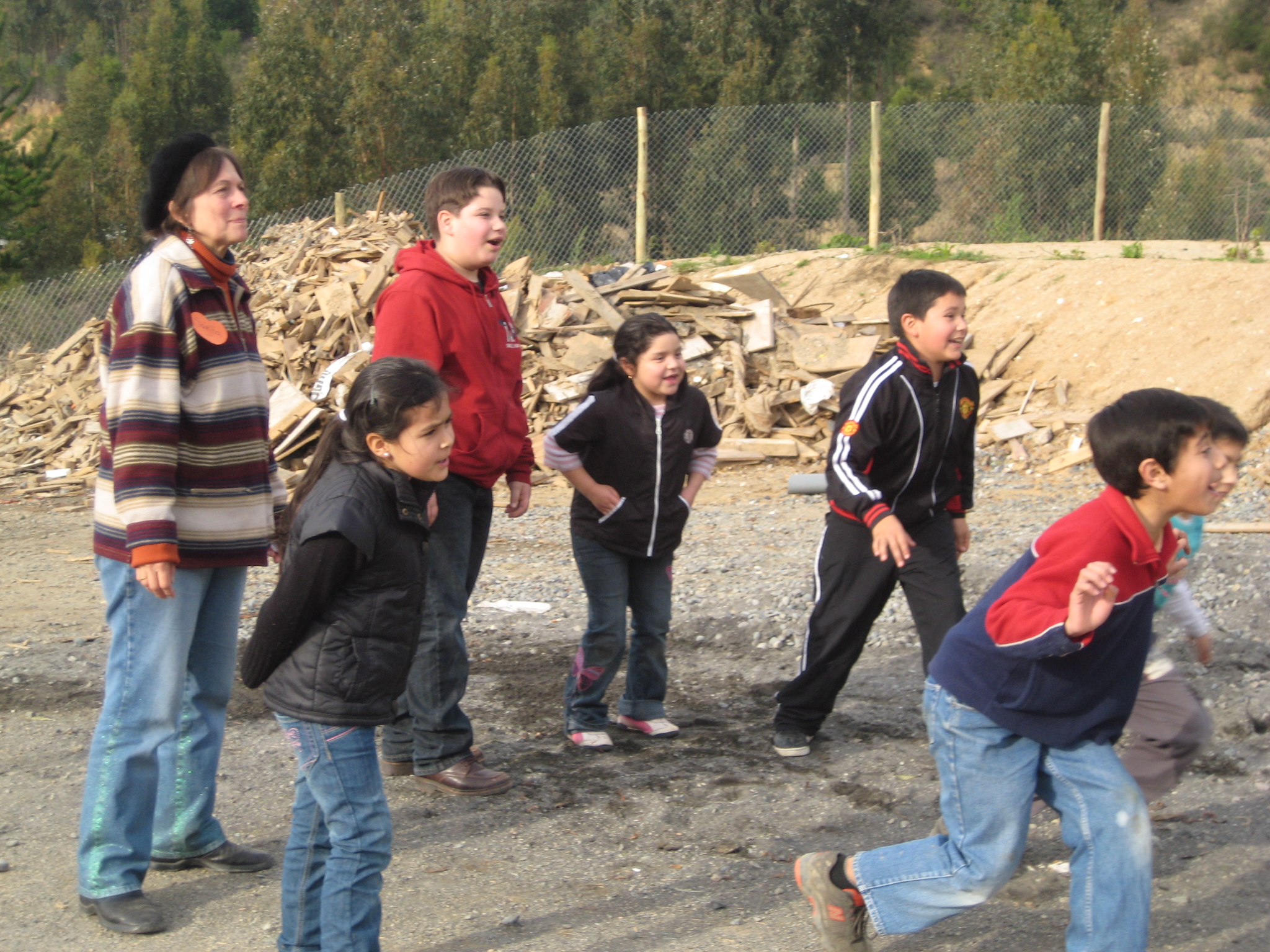
Outdoor Activities
together to maximize the use of each piece of allocated land, leading to social problems); and feeling the shame of little by little being “grouped” with the “poor of the welfare society” because of their present housing situations and living situations (it’s so easy for the world to forget the causes and merely judge by present conditions which meet the eye). In some cases stress has led to separations, break downs in community relationships and family structure, and deaths (occurring as an aftermath of long term depression syndrome).
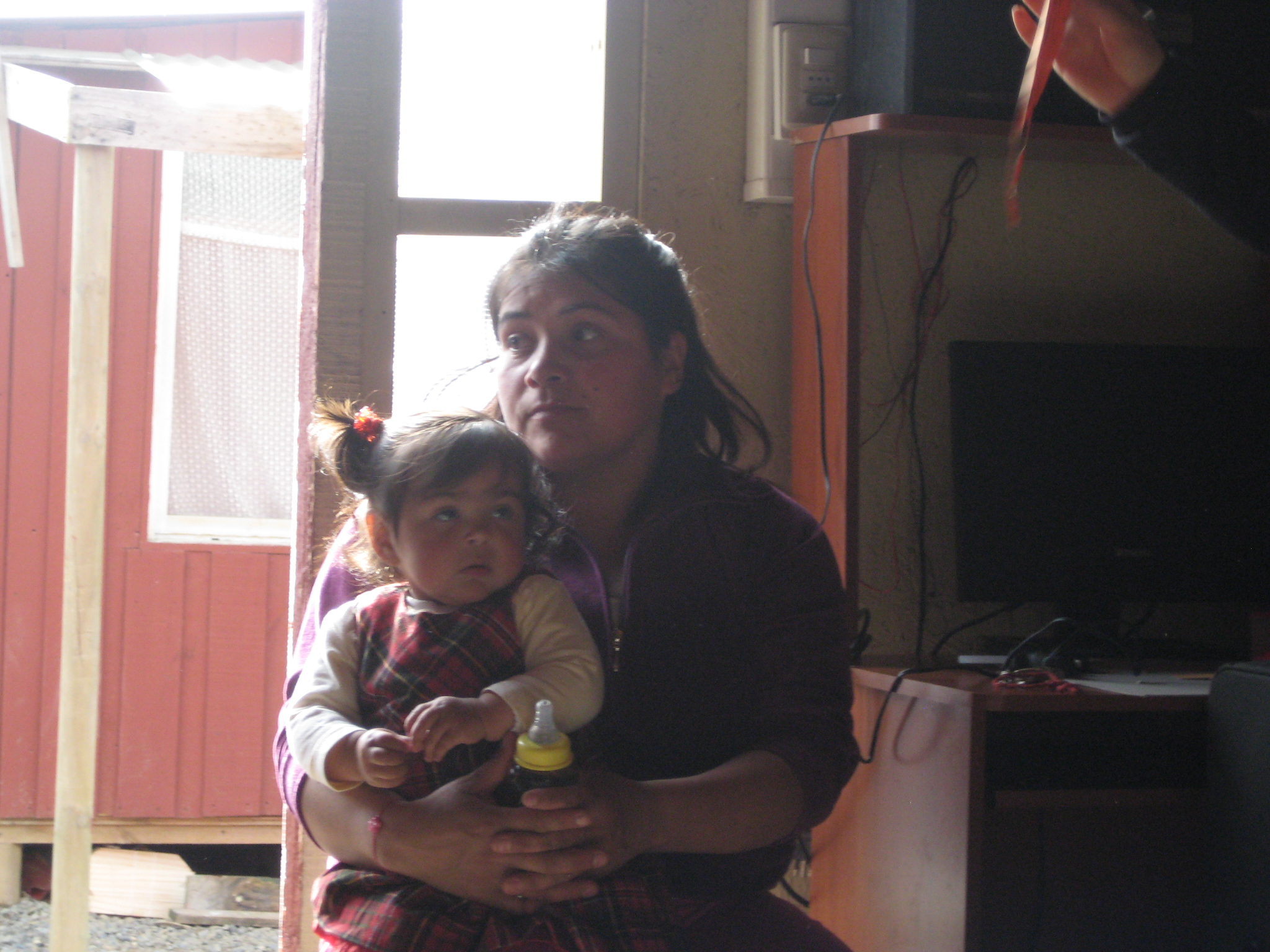
One of the moms who came with her little one to sit in on the workshop, which her son was attending. She really wants to learn skills to help her son. I admired her sample.
Since we have this therapeutic workshop coming up on the weekend in Constitucion for 100 women, I decided use my time to backtrack a bit and visit the coastal communities which lie a bit to the north of Constitucíon .
I have just returned from the communities of La Pesca, Iloca, Duao, and Lipimavida – driven out by heavy rain and high waves threatening to cover the only access road! Along that stretch of the coast the sea moved in three long blocks after the tsunami. Whereas the homes were conveniently set at a healthy three block distance from the surf, now the surf laps at their doorsteps. They are re-building their homes at the pace that they can…..what else can they do? The sea has even moved in right up to the edge of the highway which is the” life line” for these communities. They wake up every day aware that now; even a winter storm could cover the road, making access to the towns impossible! The communities are working together to try and build up a rock wall along the road as a barrier.

Class Time
The director in one school was not interested in the workshops for the children. Her comment: “The children have forgotten about the event now and I don’t want to remind them of negative things, see how they’re playing so happily outside”. Nevertheless the director of the health clinic commented how so many children are suffering……and then he rattled off the classic symptoms of trauma. He then went on to mention his concern that the incidence diabetes has shot up in the community in alarming proportions since the earthquake and he was sure there must be a correlation.
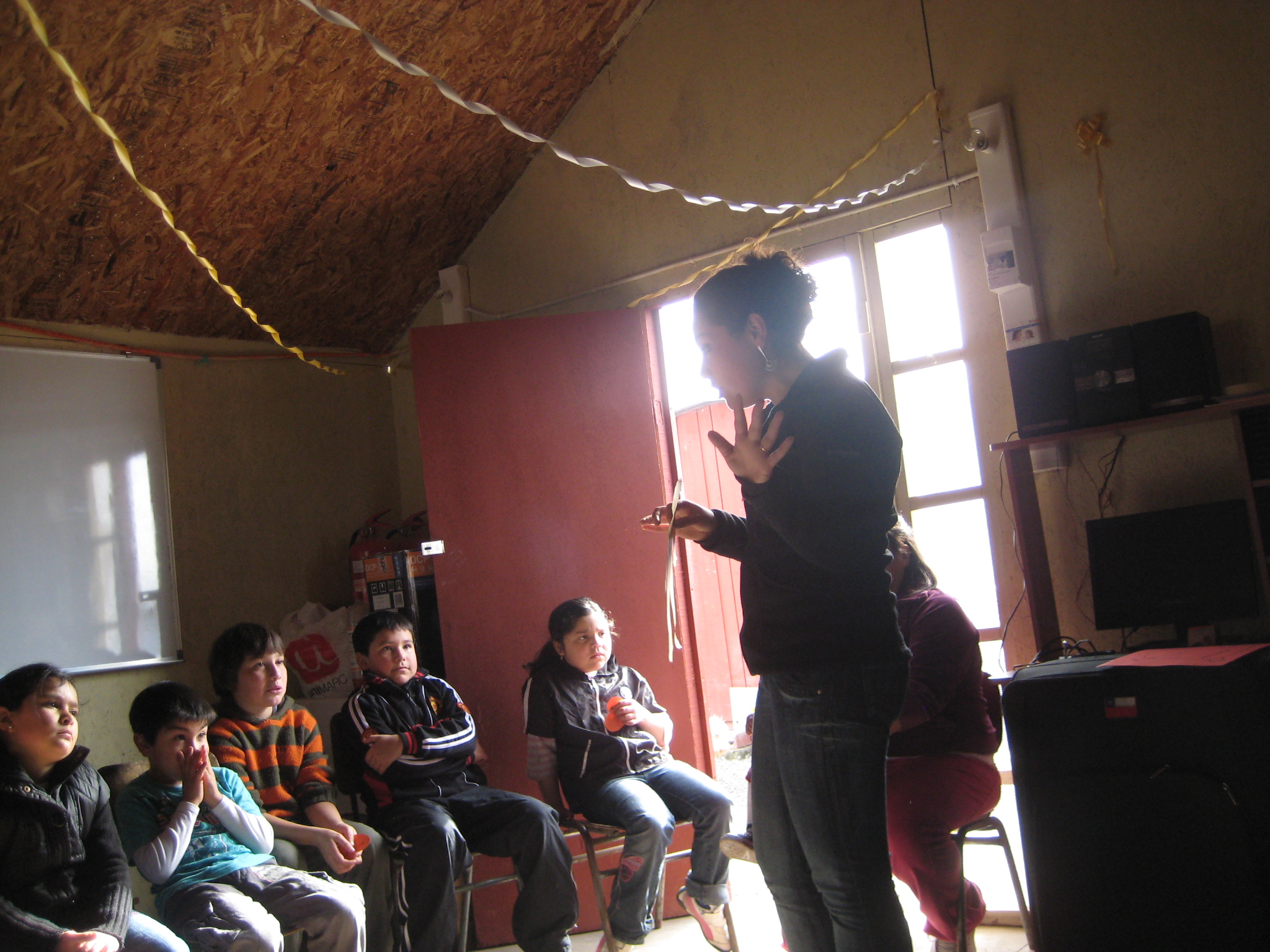
Class Time
‘The happiest people I know are the ones who’ve learned how to hold everything loosely and have given the worrisome, stress-filled, fearful details of their lives into God’s keeping’ (Charles R. Swindol)
Now, regarding the comment by the school director, here are some comments from professionals such as:
CONSTANZA BORDAGORRY from the Univ. of California, Davis campus (She is a specialist in evaluating trauma in children and adolescents, family therapy, and parent-child interaction therapy).
Comments:
“Long term trauma in children is much more of a problem than meets the eye. Depression, anxiety, and physical changes in conduct caused by post traumatic stress often go un-recognized and untreated, thus forming a common problem with both immediate and future implications.”
Now why am I harping on this, since you already know that this is why we’re doing the project “Sanando Corazones”. Well that comment by the school director seems to be significant in many areas of our social fabric today. Some through ignorance, some through just plain ignoring, and some through helplessness, have stopped the flow of much needed spiritual/moral/psycho-educational formation into world society.
Remember Eldridge Cleaver from the sixties?
Whether you shared his politics or not, Eldridge Cleaver was right: “We’re either part of the solution or we’re part of the problem”.
The truth is I’m greatly disturbed by what I see going on around me right now on a national and international level. It seems to be a social and moral tsunami that is washing over various countries.
On the one hand we see around us many groups of people who are struggling with often seemingly “hopeless” battles of adaptation and survival. On the other hand we see other individuals and groups – either victims or perpetrators of riots and destruction.
Right now in the major cities of Chile there are continuing mass protests, having to do with educational reforms, health benefits, and the high cost of living (which is especially seen in rising transportation costs). The majority of these are peaceful protests. There is even a group of high school students in Buin who have taken over their school in protest and have been on a hunger strike for a month. They are now refusing even water. I can’t help but feel that “putting your life on the line” for a cause is noble (I’m just not sure if educational reform in Chile is the most important cause to die for, especially after everything else I’ve been seeing through the project). Well, a great, old man of God once said that God Himself put that spark of idealism within the heart of youth to challenge the status quo, to change things; along with the energy to fight; but it must be channeled in the right direction.
There is also a much more violent element which participates in these protests. I was shocked and appalled that a group of rioting youth in one of Chile’s cities, actually tried to ignite and burn a young man for not wanting to participate in the protests!
How have we fallen to such a level of savagery, among the youth, in what is considered to be a “Christian” country? Isn’t savagery an attribute allocated to the “heathen”?
I’m sure the victims of the recent riots in London can chant a united “Amen” to parts of that statement.
Here’s something I read in an article from “Mail On Line|….. of London”:
10th August 2011
“If you live a normal life of absolute futility, which we can assume most of this week’s rioters do, excitement of any kind is welcome. The people who wrecked swathes of property, burned vehicles and terrorized communities have no moral compass to make them susceptible to guilt or shame.
So who is to blame? The breakdown of families, the pernicious promotion of single motherhood as a desirable state, the decline of domestic life so that even shared meals are a rarity, have all contributed importantly to the condition of the young underclass.
The social engineering industry unites to claim that the conventional template of family life is no longer valid.
How do you inculcate values in a child whose only role model is footballer Wayne Rooney — a man who is bereft of the most meager human graces?
How do you persuade children to renounce bad language when they hear little else from stars on the BBC?
(interjection: What about TV? Catholic Theologian, Peter Kreeft, says: “TV is largely a sewer pipe. Why fill your brain and your soul with the waste products from the most bigotedly antireligious elite in our society?” and that should also go for a lot of violent computer games too!)
A teacher, Francis Gilbert, wrote a book five years ago called “Yob Nation”: He described the case of a girl pupil he scolded for missing all her homework deadlines. The youngster’s mother, a social worker, telephoned him and said: ‘Threatening to throw my daughter off the A-level course because she hasn’t done some work is tantamount to psychological abuse, and there is legislation which prevents these sorts of threats. ‘I believe you are trying to harm my child’s mental well-being, and I may well take steps . . . if you are not careful.’
That story rings horribly true. It reflects a society in which teachers have been deprived of their traditional right to arbitrate pupils’ behavior. Denied power, most find it hard to sustain respect.
A century ago, no child would have dared to use obscene language in class. Today, some use little else. It symbolizes contempt for manners and decency, and is often a foretaste of delinquency.
If a child lacks sufficient respect to address authority figures politely, and faces no penalty for failing to do so, then other forms of abuse — of property and person — come naturally.
So there we have it: a large, amoral, group of young British people. They have no code of values to dissuade them from behaving anti-socially or, indeed, criminally, and small chance of being punished if they do so.
They have no sense of responsibility for themselves, far less towards others, and look to no future beyond the next meal, sexual encounter, or TV football game.” (End of article excerpts).
I found some interesting phrases in that article: “no moral compass” to guide their actions, and no accountability; “no code of values” to form decency of character; and “no sense of responsibility either for themselves or others”. Along with that I noted the mention of the “breakdown” of the traditional family. To my way of thinking, all of the above point to a lack of religious conviction – the author just forgot to mention the “bottom line” of it all. Civilization becomes a thin veneer, when it is not based on the moral principles and accountability which comes from love and respect for God, ourselves, and others; feeling accountable for our actions (fear of the Lord); and faith in an Almighty God who is still (and always will be) in control.
Tony Schwartz, HBR, August 11, 2011, points out another aspect of all of this that I feel is relevant:
“We each move frequently between at least two realities, unaware we’re doing so. The more primitive one is instinctive, reactive, survival-based and selfish.
The higher one allows us to be intentional, reflective, future-oriented, and generous. In this state, we’re capable of shaping our deepest values, delaying gratification, and making sacrifices that serve the greater good, including our own.
Ask virtually anyone to tell you their mostly deeply held values, and they’ll invariably describe noble ideals such as kindness, compassion, honesty, fairness, respect for others, courage, and generosity.
The challenge is that our survival instincts so often overwhelm our more virtuous ones. In fear (which so many of us understandably feel in these difficult times) we contract. We become more mistrustful, vigilant, self-protective, and righteous, which only makes the fissures between us grow wider.
We (too often) use our highest intellectual capacities, after the fact, to defend, rationalize, and minimize behaviors that actually violate our professed values; or to blame others, or circumstances which are “beyond our control”.
We need to actively challenge our infinite capacity for self-deception. In the simplest and most personal terms, that means seeking to hold ourselves more accountable to our deepest values, through our behaviors, every day.
We all instinctively and automatically move towards pleasure. It takes no effort to be impulsive or reactive. What’s endlessly difficult is to challenge our comfort zone, to transcend our survival instincts, and to reach beyond ourselves.
We need each other for that. Who can you recruit to push you, and cheer you on, and hold you accountable to your commitments, while you do the same for them?
We’re all in this together. Like it or not, we live in an increasingly interdependent world.” (end of article excerpts).
Didn’t Jesus say: “If ye have done it to one of the least of these My brethren ye have done it unto Me”.
As one reaches out of the confines of their little “world” with its seemingly huge and nagging problems, one catches the vision of a much greater world where the problems are so much greater also. As one learns the art of self sacrifice to extend a hand to help others, things fall into perspective in one’s own life much more easily.
There have been some heroic examples of this in the devastated coastal zones of Chile. After the earthquake/tsunami, a group of Sieks came from India, laden with blankets, and other things to give. They set up a “kitchen” in one of the communities along the coast and for some time cooked meals for all of the people in several of the destroyed fishing villages every afternoon (hey, do you know how much an Indian meal costs in a restaurant here! Humm, I do wonder if the Chilean fisher folk got into Indian cuisine?). The point is because of their moral/ religious conviction they sacrificed to come across the world and do what they could. Many others did also. In fact there is a little old Evangelical preacher, who moves slowly and a bit painfully, yet he still shows up every Saturday at one of the largest refugee camps close to Constitucíon to read Bible stores to the children. A small group of folks from the alternative medicine “Flores de Bach” have been the only ones to consistently visit several of the coastal villages to do their therapy and take the time to build a relationship with the people in those communities.
Well, what’s the point of all this?
Each of us who feels the conviction of our faith must take a radical, pro-active stance to do something to change things, especially if we are Christians. We feel the satisfaction of helping others, as a deep wellspring of joy. We must encourage others to find that same joy of “stepping out” of their small, enclosed worlds to help others also.
I want to thank each and every one of you precious human beings for helping “Sanando Corazones” keep plugging away, down through the devastated coastal communities of Chile. There are some funds coming in which I have no idea who they’re from.
God knows, and I’m sure that if you don’t get a personal thank-you from me; you’ll get it from Him (which is a much better option anyway!)

 tamingfears.com