In order to go from Curanipe to Cobquecura, one must make basically a geographical square, going inland to a larger town (Cauquenes), then taking another bus south to the town of Quirihue; then another bus west back to the coast…all because there’s only a small windy road along the coast that is mostly driven on by ox carts. By the way , poor little Quirihue was totally destroyed in the earthquake, however the residents could only watch with desperation, as caravans of food aid , clothes, blankets, etc. drove right through on their way to the coast. People in Quirihue went without food or shelter, but no one stopped. One young woman I talked to said that she and her newborn baby stayed in the back of a pick-up truck for several days, without food or water, or any shade in the hot-end-of summer sun (as no tents got distributed there until later), while her husband went to help pull victims out of the rubble and find relatives who might be trapped. The aid was going to the tsunami areas.
The sweet family I stayed with for a few nights in Pelluhue announced that they were going to that closest larger town , where I could take the bus to Quirihue. It would save me having to pay one bus fare, however, they were leaving at 5am. I would be taking the next bus around 7am to Quirihue. I spent pretty much a sleepless night waiting for 5am to roll around. Finally, I leaped up, grabbed my things and headed for the car. The trip through the coastal mountain forests was dark and windy and no one said very much. Finally we arrived, however as I got out of the car, I suddenly realized that I was missing my most important bag –the one with the questionnaires for the children in it! Oh, no, I had forgotten it in the house …had to go all the way back to Pelluhue to get it!
It amazes me how the Lord can turn even our mistakes into miracles. When I finally returned again to the bus terminal, I realized that I did not have much money. However, since it was now 10am and there was a bank in that town and the bank was open, I was able to withdraw funds to continue my trip. I probably would have had enough for a bus ticket to Cobquecura. However, I would have gotten here and found myself without money and no place to withdraw money!
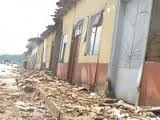
Cobquecura--After
The first sight of “colonial” style Cobquecura was quite depressing! A long street was lined with the ruins of empty store fronts and houses. In quite a few houses around the town, the rubble still fills the shattered spaces. There is such a haunted sadness on the faces of the people, as they pass the fallen shells of their houses day after day, reliving the terror in their memories. It’s hard to forget when you’re forced to look at the rubble day after day.
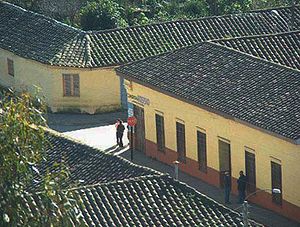
Cobquecura--Before
Cobquecura has quite an interesting history. It was founded in 1575. There was actually a port close by where wheat was shipped out to other places. Because of its stately colonial architecture, it was declared a national heritage monument in 2005. Unfortunately in the 2010 quake, 95% of the buildings were destroyed. Because it is a national heritage site, the owners of the houses don’t have the right to tear everything down, clear it all away, and build a new house, however they can. A special committee from the government must approve all re-construction. So far that committee is insisting that the houses must be re-built with the original architectural style to stay in sync with the national heritage conditions. Re-building according to those conditions will be extremely costly. No one has that kind of money and the government is not offering to pay either; so in the meantime the homeowners are staying in little huts, without running water or bathroom facilities at the back of their properties, or they are still having to live as “refugees” at relatives’ or friends’ homes. It is indeed a frustrating situation for them. It was suggested that “Sanando Corazones” offer a workshop for adults in the community which would focus on how to be strengthened through adversity, rather than just survive it. I was able to give that workshop on Saturday (Oct.8). Only 8 people showed up, yet I knew that those were the eight who needed to be there. I had asked a sweet girl who works in the Dept. of Health to come and help me. During the course of the workshop, I discovered that her husband has just been diagnosed with thyroid cancer! They’re a young couple and have a little baby. I think that part of that workshop about having faith to fight through was meant for her, and the Lord manipulated her being there to hear it!
I’ve found the people and institutions here to be very pleasant and helpful. The school offered the use of its facilities for the workshop, and City Hall provided the refreshments. They also have been very helpful taking me in the service vehicles to the different rural schools up and down the coast. There’s still a lot of fear in those coastal areas, despite the fact that a “Mt. Everest” type mountain, under the sea off these coast, deflected the tsunami and there was no damage to the coast in this area.
During my stay here, I’ve been able to visit six rural schools, where I left the questionnaires for the children and also talked to the teachers. I’ve come to realize that the teachers themselves need a lot of psycho-therapeutic support and encouragement, which often they don’t get. In this area they also form part of the community; many have lost their homes and face great difficulties, yet they must put their own personal suffering aside in order to tune into the children. It becomes a matter of always “pouring out” to others and not getting “poured into”. Well, this has become another little “side” ministry that I’ve been led to take on: to visit the teachers in the rural schools, talk to them, listen to them, share inspirational materials with them, as well as the materials which Rafael Raygada translated to help the teachers give psychological aid to their students; through psycho-educational activities and crisis preparedness.
Talking to a wide variety of people in a community helps decipher a bit more of a “global” concept about what happened, what’s still happening, and the “pulse” of how people in a community are doing psychologically. Then there’s the important information that one gleans. In this case I talked to someone who was involved with the seismograph, which had been set up before the earthquake by the government, as this area was known to be a seismically active zone. The actual reading for the 2010 earthquake at epi-center was 9.5. Since then I’ve come to discover that that the major epi-center was off the coast from the mouth of River Itata (with a reading of 10)…..making Cobquicura a 9.5 and Concepcion a 9.3
Now this is interesting because right after the quake, when I was desperately “googling” any information I could get, I know I saw that appear on one of the news sites. Then, suddenly, all news sites gave the official reading to be 8.8. Finally, it’s been explained. The official government announcement was 8.8 in order not to lose the insurance compensation for Chilean industries, as an earthquake of 9 + is considered a catastrophe and the insurance companies won’t cover damages.
In more dismal, depressing situations, one needs more miracles to stay positive. The Lord did another miracle for me, which I’m so grateful for. It’s also a sign of the Lord’s special care for me –a shiner prize. First you must understand that for 8 months now, I’ve been riding local buses some nice and some quite dirty, staying in a wide variety of places (including private houses with families, huts in devastated rural areas, cheap hotels, guest houses, – some of those places were pretty primitive and even dirty – but considering that there are communities still in ruin from the earthquake, I’ve been just grateful for a place to sleep. However there has been high price to pay in the form of life’s inconveniences (like no place to wash clothes, no place to shower), bugs, and nasty little creepy-crawling critters that come with that “turf”. I consider it part of “becoming one” with the folks I’m trying to understand and help through Sanando Corazones.
Here in Cobquecura I started off staying in a hotel. It was okay, but it was getting quite expensive as the days went (by the way some surfers were staying there too. They told me that they’d surfed in a lot of different countries, but to them, the waves in Buchapurreo are the best – so heads up surfers!). Then I met Silvia – an interesting woman indeed! Silvia is an artist, with an eye for order and beauty. She lived in the States for 35 yrs., after she was encouraged to immigrate there in 1973 (during the military take-over). She’s always been an idealist and concerned about human rights and justice, which is reflected in her art in interesting ways. Upon hearing about Project Sanando Corazones, Silvia invited me to stay at her bed and breakfast (www.laloberiachile.com) – with a cultural, colonial décor in which each room depicts a famous literary figure from Chile’s past. The house itself is part of the Chilean Cultural Heritage monuments, actually one of the only existing ones, since Silvia has totally renovated the colonial house and interior garden, along with establishing a museum of historical and archaelogical pieces from this area of Chile.
She feels a commitment to the community to raise the standard of quality of life, doing whatever she can to help. Being the enterprising visionary that she is, she constructed a refuge at a point up on the mountain, which came in very handy when the earthquake struck and everyone had to “head for the hills”.
It has certainly helped my quality of life to be staying in this lovely bed and breakfast, with a bathroom which has hot water, a washing machine and dryer in which I could wash my clothes, real coffee…..heavenly and engineered by the Lord. I don’t think I would have appreciated it as much, had I not had such a need. Isn’t that the way it goes with life in general?
One more thing about the garden court yard; there is a large tree, which is some kind of cousin to the ordinary honeysuckle. Every afternoon it is visited by huge humming birds. They’re called Patagonian Giant Hummingbirds. They do the typical humming bird thing, except they’re not quite as fast as regular humming birds (just because of their size!). That makes it easier to observe them.
Since Cobquecura is part of the 8th region of Chile, I’ll be continuing south in a few days for Dichato, where the tsunami totally destroyed the town. Then I’ll be returning to Curanipe/Pelluhue for a workshop which is being organized for women one day and children the next day. That will be the 22, and 23 of Oct. Margaret will come to give the workshop….if you wouldn’t mind keeping that in your prayers. Woops! I’m getting this off so late, those dates have passed. The workshops went super well! Please pray for a follow-up workshop that we’ve been asked to do on Nov. 12th
Lastly, I just want to say, Thank you. When I start feeling a bit weary in well doing, I’m finding that what’s convicting me to keep pushing ahead is your support (both moral and financial). I have a responsibility to meet and I can’t let you down. That motivation is a lifesaver for the project as its keeping me going.

 tamingfears.com