A lot of people, even in Chile, have never heard of Perales. Until about 20 years ago the road from Coelemu to the coast was so bad that you could only trudge through by ox cart (and I heard that it required some strong oxen to force their way through the deep mud in winter and the deep dust in summer). Nevertheless, it wasn’t always that way. Perales, Vegas de Itata, and Meipo are communites along the Itata River as it meanders along and flows into the Pacific at Perales. The Itata is a beautiful river, along with the countryside which surrounds it.
Up through the early 1800’s, Vegas de Itata (up river a bit from the mouth) was a booming port; in fact it was quite the city. Large buildings housed the municipal offices, stores, mail services, as well as plenty of entertainment facilities. There was never a dull moment (day or night) in this bustling city, as grains were loaded onto ships and sent off to faraway ports.
It is also said that right up from the mouth of the river Itata ( around Perales) was a hang-out for pirates. Perhaps they waited out winter storms there, or restocked supplies, or socialized with the locals, or just went around hiding their “booty”. Some years ago a farmer found a treasure while plowing his field to plant potatoes (hum, maybe that’s another meaning for “cash crop”).
Well, all that changed in 1835 when an earthquake and huge tsunami totally destroyed Vegas de Itata. Today the sleepy little community consists of a few houses, a small rural health center (which shares its space with a few policemen), a school, and that’s it. If you look carefully through the tall grass, you might find remains of foundations which have sunk into the oblivion of time. Now Perales has a larger population. …though for rather interesting reasons.
Perales also has quite a colorful history. It is said that at some point in the past it was a gyspy settlement (hum….gypsies, pirates, sailors…..quite a combination!). The inhabitants of Perales have interesting physiological features which tend to suggest some genetic mixing.
Well, it seems that Perales was quite a wild place…..drinking, fighting; a rather lawless society “unto themselves”, especially being so isolated on their tip of the coast, after the port no longer functioned. Rather than fishing like their neighbors, the men of Perales would leave for months at a time to larger cities, where they would sell and trade whatever they could get their hands on to sell or trade.
Around 1960 a Chilean, an Evangelical, felt the call of God to go to Perales as a missionary. It was a tough go for him, as the inhabitants even tried to kill him. But he stuck, he persisted, he wooed, he planted, he preached….until little by little he began to win the battle of the believers. When I arrived in Perales 50 yrs. later, at least 80% of the population are Evangelical and go to his church. He is well over 100 years old (according to his daughter) and in poor health. He appointed his grandson to take over the church (the grandson’s wife is the director of the school). The effects of an entire community becoming evangelical (primarily the women) are quite interesting to observe. The women all wear skirts with boots, long hair, and neatly rolled into a bun in the back.
The boys usually stop their education after the basic “read’in, rite’in, and rithmetic” so that they can go with their fathers to sell. The girls usually marry around 13 or 14, as this assures that the girls do not get pregnant out of “wed lock”. The girls then begin their lives of bearing and raising children and keeping the home going (while their husband is away selling). The church has become a source of solidarity among the women, as well as spiritual support. Women tend to gather in the evenings together in different homes to knit, crochet, or embroider, while fellowshipping. The community has become very orderly without the drinking and disorder that there was before.
Perales suffered much destruction as the tsunami wiped out virtually the entire coastal area. Vegas de Itata was much less affected this time.
Since there was no place for me to stay, I was invited to stay in one of the “refugee” shacks with a family (they sent their children to sleep with the grandmother so that I could have a bed….so sweet!).
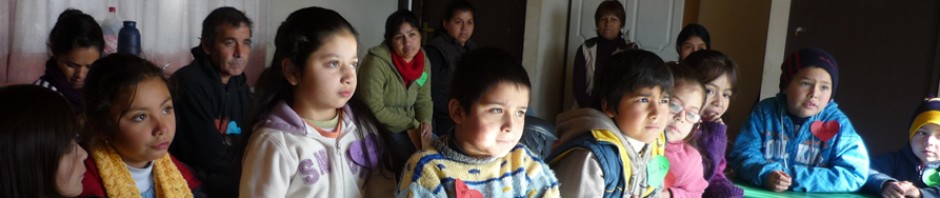
I was able to visit the three schools along the river. I talked to the children, even gave a couple of “classes” along the way. The children took the survey to see how they’re doing as far as “stress and trauma”, after everything that’s happened to disrupt their lives. It was very encouraging for me to be able to meet with the teachers and share the material that I have. By the way, I’ve been adding more and more new motivational material so I have quite a presentation now. It’s interesting how something like the song: “Gracias a Ti” (a praise song by Roberto Carlos) will lead the conversation onto a more spiritual level, without me obviously pushing in that direction. I also use the interview that Nick. Vu. (the on-fire Christian missionary and motivational speaker without arms or legs) gave in “Good Morning Chile” where 5 people from the plane that crashed were in attendance. The interview was a powerful proclamation of faith and “hit the nail right on the head” as far as what Jesus’ love is all about. In the evenings women would come over to the place I was staying, and we’d talk, sometimes till quite late. They were quite curious about who I was, where I came from, what I believed, what life is like in other places, etc.
I also had a chance to talk to the health workers in the different communities, which gives a more complete overview of life in their part of the world.
There are a couple of things that I notice with interest about those communities. A bit inland there were large haciendas. In some of the communities people were quite tied to those and have a history of agricultural roots. In other communities (like Perales) no……that has made for quite a difference in world view and attitudes.
In Perales, where the girls marry at a very young age and begin their “career” of family and children, they have been quite secluded in their community and “their role”. As the husbands leave for the cities, the concept of the “world” becomes very different for the man. The man faces other life styles, even temptations, which have secondary effects on their women “back home”.
Since the earthquake and tsunami wiped out the stores in Perales in 2010, no new stores have set up to replace them. That means that everyone has to travel quite a distance to the nearest larger town, “Coelemu” to shop for food and other necessary items. It seems that women are” getting out and about more” now (maybe that’s why the stores haven’t opened back up in Perales!). There can be quite a tendency to become lonely and depressed so women traditionally have depended a lot on fellowship with each other and with their church to fill the social void in their lives. It will be interesting to see what happens as women continue to have more contact with the outside world.
Of course the 2010 factor has had massive repercussions on the people of Perales. Most of them lost their homes and are still living crowded into temporary camps, with little privacy; having to share primitive laundry and washing facilities, and public chemical outhouses with many others. People wanted to take me and point out the ruined foundation of what was once their very nice, well furnished home. It seems that their “faith base” and strong community ties have helped them to keep going, or at least to remain stoic. Nevertheless, it became clear to me that no matter how much” religion” a person has, each one needs encouragement to exercise their personal faith in times of testing. We really do need each other….and that “we” cuts across all lines of culture, religion, and society! It’s the Lord who works the miracles of making people cross each others’ paths in order to be His Words of encouragement, His great Heart to love, His Hands to touch and heal, His Arms to comfort and hug, and His Mind to clarify and instruct. Sometimes that all happens in the strangest moments of time and in the most peculiar situations; which is what gives excitement to life, right?
In my case, thanks to each of you who has been faithfully with me in all of my “moments” and “situations” through your support, prayers, and help.

 tamingfears.com