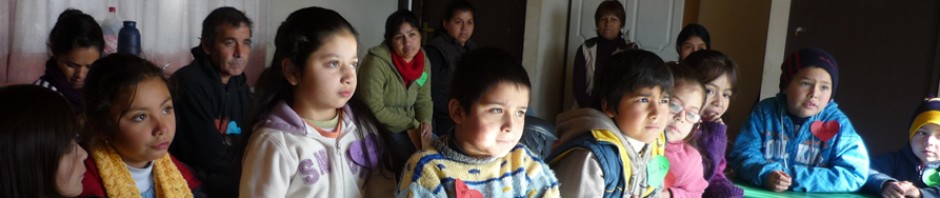
 After having taken trips to the areas which were devastated in the tsunami/earthquake, I have the desire to continue working in the affected regions, conducting workshops with the children who were directly affected by the disasters, through loss of homes, loved ones, etc. There is still a need because there are continuing tremors in those areas and living situations have not returned to normal in many cases.
I had the opportunity to help conduct seminars in 2 camps and one shelter in Constitucion, using material which had been prepared by the Univ. Catolica – Depto. De Sicologia de Santiago, Chile. On that occasion our volunteer team divided the children into groups in order to conduct the workshops, while the other children /young people participated in games and activities. We were privileged to be able to utilize the expertise of Margaret Galarce, a child psychologist who directed the workshops.
What I recognize to be an important need among children, who have been directly affected by disasters, is that of helping them to develop the ability to cope with fear and the inertia which comes through fear.
This goes along with the need for them to find channels to be able to express what they feel inside, in order to find positive ways of “managing” those interior feelings. Once they can do this, they will be able to build bridges toward taking positive steps of action in their lives.
The project which I am proposing would follow a sequence of steps. The first step would be a visit to a devastated town. Contact would be set up with key people in the refugee camps for conducting the sessions with the children.
Illustrated story /coloring books, addressing the target theme, would be printed out for each child. A team of volunteers would then take the material to specific refugee camps (set up for those families who lost their homes and properties along the coast). Interactive sessions would be conducted among small groups of children and young people ( by ages), using the material as a means to open dialogue. Additional counseling techniques, such as dramatizations would also be employed.
Upon completion of the sessions in one camp, the volunteer team would move onto another camp in the same city, or move onto the next town. The team could possibly do two camps per day.
The areas devastated by the earthquake and tsunami would be first in line for the sessions.
Upon completion of the sessions in the coastal towns, the team would move to the interior to towns devastated by the earthquake. In those towns the team would set up contacts in the schools in order to conduct the workshops by classes. In the areas devastated by the earthquake, families retained their properties, where they then built make-shift shelters. Because the children in those areas would be reached through the schools, the sessions would be more numerous, being conducted by class.
In larger urban areas such as Talca or Curico, y Concepcion the team could work with social workers to pinpoint those families who were most affected by the earthquake. The therapy sessions would specifically target the children of those families. In some cases, the team would be prepared to conduct the sessions in health service centers or hospital facilities for specific groups of children.
Under ideal circumstances the team would have the use of a small RV to remain mobile for extended periods of time. Funds would be needed for RV rental, gas, tolls, living expenses for the volunteer team, while on the road, printing costs for the visual material used, rent for a “base camp” for volunteers (together with storage facility for the printed materials), and operating expenses (including telephone costs, internet access costs, etc.) .
Project time table is calculated at a minimum of 6 months to cover the devastated areas, with the possibility of the project extending to 8 months.
When looking at such a project with a wider lens, the more far-reaching effects can be appreciated. This project could set up the parameters and provide the material for similar projects in other areas of the world, where the same need also exists. Considering that this type of therapy workshops for children is geared toward long term effects in their lives, the precise amount of time which has passed from the disaster is not inhibitive to the effectiveness of the workshops.
 tamingfears.com